Thursday, February 9, 2017

Maryland Heights: Are you Meeting Needs and Wants of Our Community?

Maryland Heights: 
Are you Meeting Needs and Wants of Our Community?

Problem:
Is our city meeting all of the needs of its residents?


In the beginning:
Students brainstormed needs of people. The list was extensive (I forgot to take a picture of it! ugh!)

Then we searched the online business pages to see if Maryland Heights has businesses to address all of our needs. We used Google Docs to work together. This is what we discovered:


Students brainstormed businesses they had heard of that could address our needs.

We are on a roll!:
Next, students selected the type of business in which to send letters. Students decided it was best to stick to one type of business so that they could write similar letters.

Students brainstormed what to include in their letters to encourage businesses to look at Maryland Heights as a future business location. We looked at Maryland Heights' population for daytime and evening/weekends, available real estate, and building codes. Students also thought mentioning the very little competition they would have since the purpose of our project was to identify needs and wants not being met by our city.

Here is a sample letter:


Getting so close to finishing!:

Students wrote letters to their businesses.  Addresses were found on the Internet. All letters were mailed off by winter break.


Responses!!!:
Wow! The responses have been coming in! Diego's response came in first, within seven days of sending out the first round of letters. Businesses are impressed with the type of information provided in our letters. They are in awe with the fact that the students knew to think about daytime population and building codes. Overall, I believe many of the businesses leaders we contacted found our letters inspiring to consider Maryland Heights for future business endeavors. 


Diego received a $10 gift card to Half Price Books!


Daniel received a lot of goodies from Wendy's.
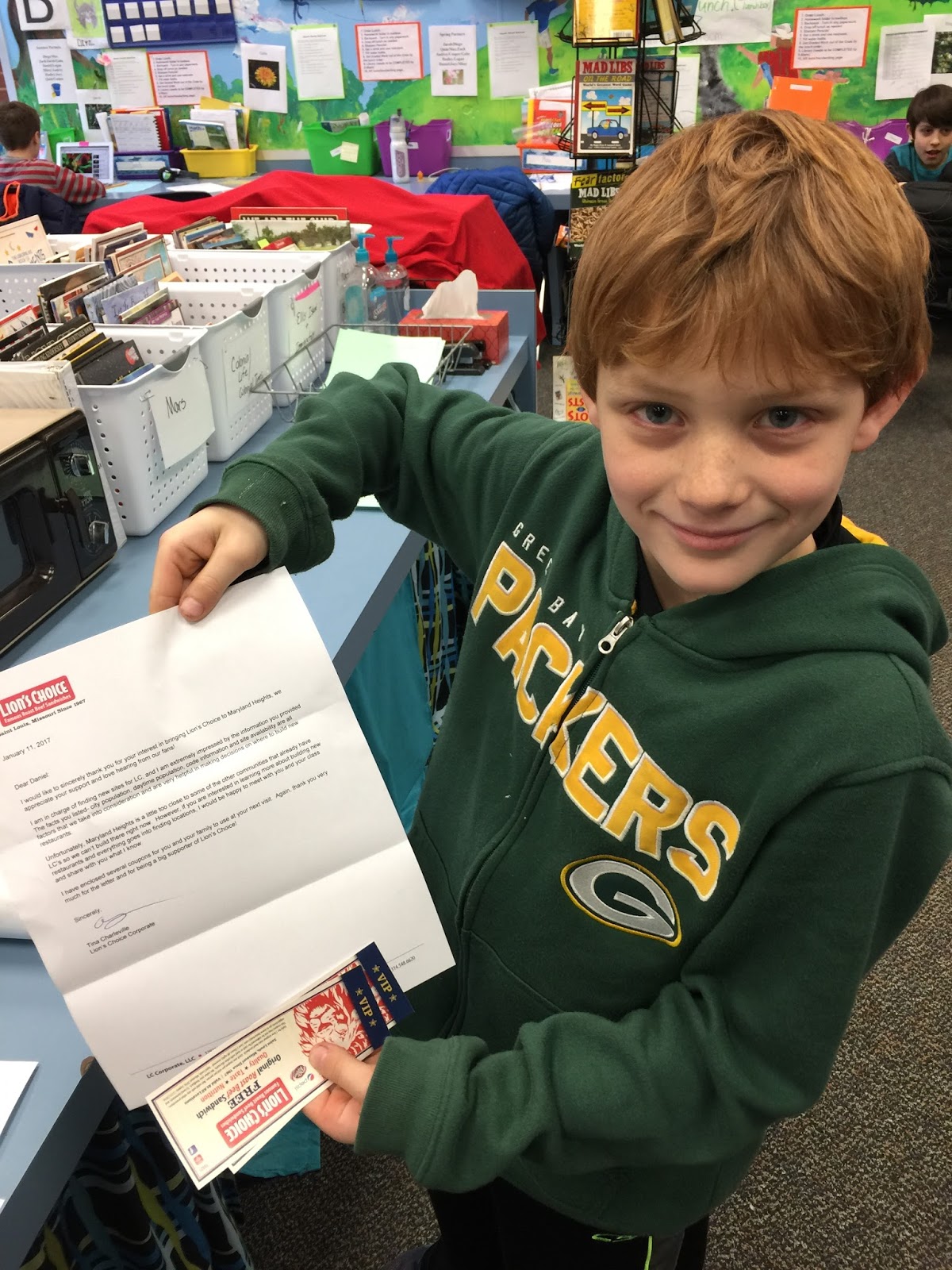


Lion's Choice sent coupons to Daniel.  Lion's Choice also said they would visit our classroom and that they would host a fund raiser for our school, program or classroom.


Results:

All businesses were impressed with the letters to students wrote. Some businesses are unable to open businesses in Maryland Heights due to proximity to their other stores.  However, businesses such as Half Price Books,  Payless Shoes, Olive Garden, and Michaels indicated that they will forward our request to the department in charge of selected new sites in the future.

One business, Lion's Choice, offered to have a fund raiser at one of their locations, and, to visit our classroom to talk about what it takes to open a business!  We will be contacting them soon!


Who will we hear from next?


PEGS Ponders Recycling....

Landfill Contraptions:
Solutions to Reclaiming Useful Disposed Resources


What's the Problem?:
PEGS students gave a lot of thought the recycling and trash.  We reviewed an interview about the activities that occur at a landfill. Students witnessed how different forms of trash are separated and collected for either landfill or recycling purposes. Some landfills are not equipped to separate.

The problem was posed to them to create a contraption that could sort trash and reclaim a usable resource (or more than one).

We reviewed circuits and batteries to make sure students were familiar with how electricity could be used. 


First:
First, the students designed their contraptions on paper. Each student designed their own.


Second:
Designs were displayed throughout the room. Students walked around with post it notes, leaving comments and questions for the designer to consider. 

Students then reviewed those comments, clarified drawings, and made revisions. A few students actual redrew their ideas into a new, more developed idea.


Third:

Then in groups they discussed their ideas. As a group, they took the best ideas from each person and made a new design.


Fourth:
Finally, as a group, they created their contraptions. Here are their results. Dr. Furjes came to our classroom to view the two group contraptions.  He asked many questions, clarifying questions.  He was quite impressed with what they made from our makerspace area!  One contraption was a conveyor belt made from a skateboard, fan blades, sewing machine motor and pedal to control speed (found on the side of the road, none the less!), and a lot of other miscellaneous parts.


System #1:
This system separates magnetic items from trash. As the magnet collects items, the robotic arm moves over and drops the items on the yellow plate. 


System #2:
This system separates several items: magnetic, plastic, paper and the rest fell down into a bucket. The box contains the fan that blows the paper into a catcher. The fan is controlled by a sewing machine motor which has a pedal that can control speed!  The conveyor belt was manual controlled. The students tried a few motors and were having difficulties.


Reflection:

Working as a group:
Students discussed with me the benefits and difficulties working in a group on this kind of project. Benefits included how one person's ideas help you develop your own ideas.  However, it is difficult to decide which ideas to use because sometimes you really like your ideas and you really do think some of your ideas are better.  In the end, however, your group invention usually comes out better and more detailed when you work with others. 

Making contraptions:
Students mentioned the difficulty of drawing their ideas on paper. They also mentioned that when designing with items, the end result may not look like the idea on paper.  Sometimes ideas on paper CAN'T be made into the actual model.  Making models can be dangerous and wearing safety goggles is important. Also, moving parts, like fan blades, need to be in enclosed spaces such as a box.

Sharing:
Our contraptions were demonstrated to staff members.  Community members viewed contraptions. All provided thoughtful questions for the students to ponder. Overall, the audience members were impressed with the designs and didn't have much else to ask. 

Tuesday, September 13, 2016

PEGS Rethinks Remington's Play Ground

PEGS Rethinks Remington's Play Ground!

How did this start?

Mrs. Robinson and Ms. Logue were prepping our students for recess at the beginning of the year. Recess can be a difficult time for exceptionally gifted students and students who are new to a school. As a group, we were discussing how to make friends and what we could say to find someone new to play with at recess.  During this discussion, students mentioned that there isn't much to do if you don't want to play kickball, basketball or climb on play equipment.


This led to us thinking about what else students could do outside. Then our conversation led to how some playgrounds have hopscotch, four square and other activity outlines painted on them.

PEGS decided the play ground needed activities like that and more painted on the asphalt. So, we brainstormed ideas, found pictures of those ideas (and more) online, and then we created an online survey using "survio.com" for students in grades 3-5 to take. Here are some snapshots of the survey:


The class analyzed the results and decided what we should include in our play ground design.


Then, what did we do?

Below are pictures of the process so far.


Students are moving around made-to-scale-templates of play ground ideas on a made-to-scale playground made out of graph paper. This is for the back upper play ground.


These 5th graders are measuring out the larger play ground on graph paper.


These are a few designs of the upper playground.


These students are measuring the outside play ground. We needed more measurements (placement of basketball poles).


Here the boys are checking our measurements. Measure twice, cut once! Right?


These students are measuring and placing the basketball poles on the play ground template.


Now, they are placing the basketball court templates on the play ground template.


Presenting the Idea

Students met with our principal to present the idea. Each student had a role in the presentation. The feed back we received included finalizing prices on materials and equipment and contacting the PE teacher for any further ideas.


Pricing and PE Teacher

We used Google docs to create link to the prices for the needed materials and sports equipment. We shared this document with our principal, Dr. Furjes. In addition, the PE teacher reviewed our plans and did not have any further ideas. 


Final Meeting

We met with Dr. Furjes for the final time in our planning stage.  The only concern is the Ga Ga pit right now. Other than that, Dr Furjes says the project is a GO! He told the PEGS students that this was a well thought-out project.  


Our project is a "GO", on a modified plan. We might have a new parking lot installed in the spring and summer. So, we will ask for basic painting for now, no colored in painting at this time.

A parent volunteer is going to write a Pattonville Education Foundation grant to see if we can get our sports equipment purchased in this manner. Students will be a part of this process. 

I will be emailing the district to see if district maintenance crew can paint the four square, hop scotch and basket ball half courts.  Students will be a part of writing the email.

Things are moving forward!

2/9/17

Guess what happened over the weekend?? Our playground was painted with several of our ideas!


Hop Scotch


4-Square


Running Lanes and Basketball Courts


Bonus!  Traffic Lanes for after-school pick up and before-school drop off!


Results!


Students Interacting With Others

For some, this is new!   Students also were playing games that they didn't normally play.  When the students saw the painted lines and activities Monday morning, students jumped out of their parents' cars and were so excited! Some of the kids said "Thank you!" to Mrs. Lambros (they know she works in the PEGS classroom) as they walked into the school. 


Learning Standards Addressed so far:

3rd Math

  • Estimate lengths using units of inches, feet, yards, centimeters and meters. 
  • Measure to determine how much longer one object is than another. 
4th Math
  • Analyze the data in a frequency table, line plot, bar graph or picture graph.
  • Solve problems involving addition and subtraction by using information presented in a data display.
  • Use the four operations to solve problems involving distances, intervals of time, liquid volume, weight of objects and money.
  • Apply the area and perimeter formulas for rectangles to solve problems.
5th Math
  • Solve and justify multi- step problems involving variables, whole numbers, fractions and decimals.
  • Write, evaluate and interpret numeric expressions using the order of operations.
  • Multiply multi-digit whole numbers and decimals to the hundredths place, and justify the solution. 

 Guidance and Counseling


  • Domain 2: PS 2 Interacting With Others in Ways That Respect Individual and Group Differences